


Labor Force Demands for the Digital Age
White paper by Carrie Goetz, Principal/CTO, StrategITcom
Today’s data center headlines have common themes, with artificial intelligence (AI), power, and workforce leading the focus. The headlines tell us that with the advent of AI the amount of data center power demand increases to varying degrees based upon the particular implementation of AI. Non-AI data centers are also demanding incrementally more power to support new and growing applications, storage, computing speeds, processing density increases, and integrations for supporting infrastructures.
Projected data center demand
To highlight this increase in demand, one Lawrence Berkeley National Laboratory’s study on data center demand, estimates that data centers will consume between 325 TWh and 580 TWh annually of electricity by 2030. This number represents 6.7% to 12% of all U.S. electricity consumption. Quite the power increase from the 4-5% that IEA estimates data centers consume today.
Most models show some variation of power demand growth. The variances are based on the level and speed of AI uptake, types of AI functions, coupled with organic data demand growth. Most models point to a 2–3-fold increase in power demand over the next 4 years. More power infrastructure requires more infrastructure, talent, and supporting resources.
Growing demand for power in the data center similarly increases demand for power backup storage solutions in equal measure. According to this study from LBL, "The results presented here indicate that the electricity consumption of U.S. data centers is currently growing at a compound annual growth rate of approximately 7% from 2014 to 2018, increasing to 18% between 2018 and 2023, and then ranging from 13% to 27% between 2023 and 2028."
Regardless of the study, the results are clear that data center energy growth shows no sign of slowing down. More energy equates to more energy source demands and more demands for energy storage. According to Modo Energy Research, “U.S. battery energy storage capacity has grown from 1 GW in 2020 to 17 GW in 2024 and could reach nearly 150 GW by 2030.” To foster this growth, the United States has enacted legislation to encourage building self-sustaining data centers and remain technically advanced.
Projected impact of legislation
The One Big Beautiful Bill Act (P.L. 119-21) passed in 2025 changes some of the specifics for data center construction and sourcing of materials. Some if the impacts are listed below. Additional incentives are expected as legislation and competition around the globe continues.
Ubiquitously, talent will be increasingly critical to completion timelines and ongoing maintenance and repair. Other acceleration legislation is expected here and around the globe. Some legislation is tied to product origin; other rules provide tax incentives.
A summary follows:
| Provision | What it Does | Timeline | Impact on Data Centers |
|---|---|---|---|
| Clean Electricity Tax Credits (45Y PTC & 48E ITC) | Accelerated phaseout of production & investment tax credits for wind, solar, and most power storage | Must begin construction by July 4, 2026 or be placed in service by Dec 31, 2027 to qualify | NEGATIVE– Many hyperscalers lose less expensive renewable PPAs for “green” power claims. Alternate power sources for generation will be needed. Alternatively, deployment of renewable power will be devoid of government tax incentives. |
| Foreign Entity of Concern (FEOC) Rules | Strict new sourcing & ownership restrictions for batteries, solar panels, renewable components, etc. | Applies to projects starting construction in 2026 and moving forward. | NEGATIVE –many supply chains now disqualified. Increased need for US built components and manufacturing. Increase in construction talent to build US based facilities. |
| 100% Bonus Depreciation | Makes full immediate expensing permanent for equipment, servers, switchgear, PDUs, cooling systems, batteries, and qualified improvement property and factory spaces. | Permanent (retroactive benefits available) | STRONGLY POSITIVE – Large tax savings on massive capex expenditures versus long term depreciation. Accelerates construction to meet deadlines to capture depreciation expensing. |
| Shift Toward Fossil & Nuclear | Expands support for natural gas, coal, and nuclear while rescinding some unobligated IRA clean-energy funds | Immediate | POSITIVE FOR GAS/NUCLEAR-BACKED PROJECTS – Encourages behind-the-meter generation and self-funded power. Increases demand for power educated individuals. |
| March 2026 Ratepayer Protection Pledge | Voluntary pledge between the current administration and 7 hyperscalers to ensure that they do not increase grid prices to consumers, but rather self-generate | Ongoing | Increase production of substations, modular reactors, and other power source structures to operate autonomously from the grid or supporting the grid. |
The workforce conundrum
In order to bring new power online, build new facilities, and operate them, we need to address workforce shortfalls. According to a 2025 Uptime Institute survey, 2/3 of operators globally struggle to find talent. Increasing power and backup power loads means increasing demands, particularly, for electrically skilled personnel. Electrically skilled positions within the data center space alone are set to increase roughly 8% through 2030.
While 8% may not seem like a large number, the competition for both existing and newly skilled workers continues to increase within the industry and amongst other industries. The data center industry competes with every other sector out there relying on electrical talent. The JOLTS (Job Openings and Labor Turnover Survey) report from the BLS (Bureau of Labor Statistics) data focused on the skilled trades and related sectors. The most recent JOLTS release covers February 2026 (preliminary data): Total U.S. job openings for skilled labor stands at 6.882 million (down from about 7.24 million in January 2026 and higher levels in mid-2025) showing clear fluctuations in labor demand and supply.
To further complicate things, existing skilled workers are retiring at a rate of 20,000-30,000 per year, increasing demand yet again. The data center sector alone estimates 300,000 electricians (Fortune/IBEW) are needed to fill current voids. The mission critical industry needs talent throughout manufacturing, testing, construction, commissioning, sales, operations, maintenance, and replacement systems, to name a few. Skills are often transferable between sectors within our industry. As such, operators often look to poach talent from other facilities because skilled workers are not readily available. Poaching results in talent voids elsewhere and leads to artificially inflated wages. This model is not sustainable long term.
Focus on mission critical
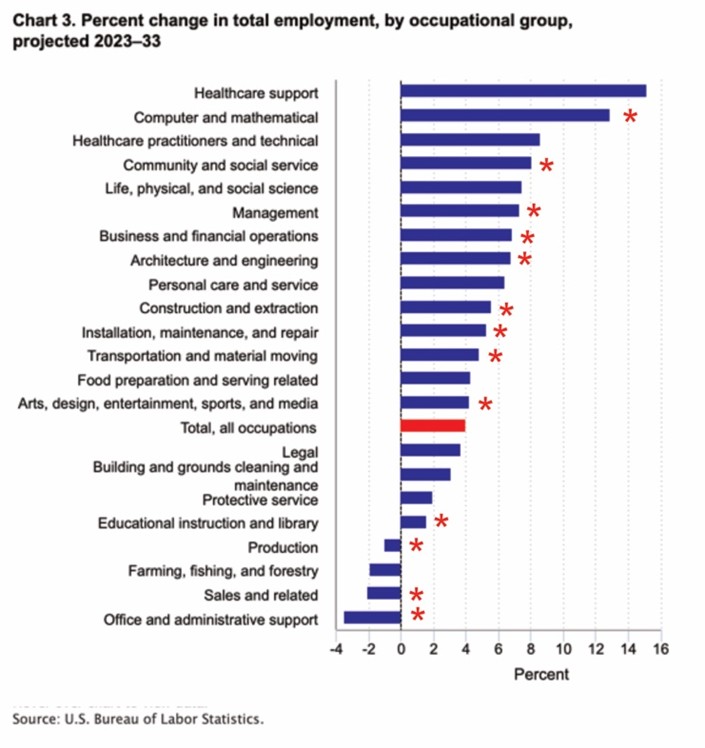
While all countries have similar problems and varied potential solutions, the United States is predicted to have the highest growth in construction, fit outs, and density increases. We will focus on this market for example. In the chart below from the US Bureau of Labor Statistics, we see expected increases across various CIP (Classification of Instructional Programs) codes. For clarity, a red “*” is placed beside the codes that are directly in demand in mission critical, although others have minor placement possibilities, also.
But as is evident, the mission critical industry will exhibit quite a surge of employment opportunities while competing with other industries for the same talented professionals. According to MikeRoweWorks, there are 7.6 million open positions in the U.S. alone, most are within the realm of trades. Many don’t require a degree, relying on a combination of technical education and on-the-job training.
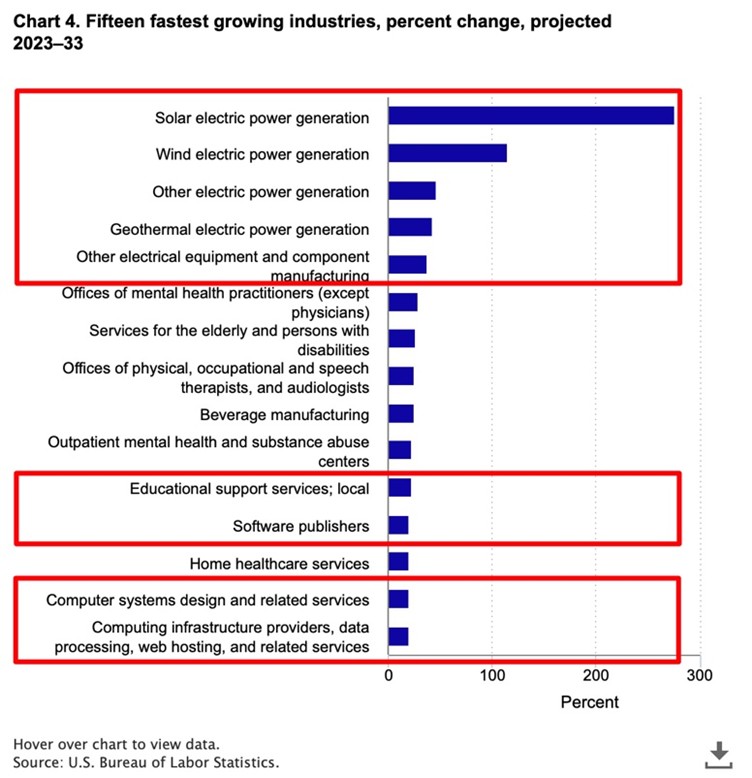
Of the fastest growing job categories within the Bureau of Labor Statistics study in Figure 2, the vast majority are also in demand in mission critical. Generating power for data center workloads is going to require not only utility companies to step up, but also data center builders, providers, hyperscalers, miners, and other high performance power users.
Data centers will launch their own power generation systems either grid attached, or operating in island mode autonomous from the grid. Wind and solar have a share of government grant money in many countries, but natural gas sites, geothermal, and small modular nuclear reactors are gaining traction for onsite generation. Innovations are forthcoming and encouraged.
Training and programs in electrical topics
Overall costs of electrical systems equate to 45-70% of the overall construction costs for data centers depending on density. It is obvious that a lack of workforce can cripple growth. Electrically trained people can work across many specialties within a facility including UPS systems, batteries, generators, switch gear, PDUs, distribution, and capacity planning making electrical work a highly desirable career choice. Data centers have relied heavily on standards, skilled trades, and certifications to make up for the lack of college level courses. A balance of degreed and non-degreed people is needed to fill voids in the workforce.
According to AI estimates based on queries across 3 models, for every 40-60 programs offered in vocational technical schools and colleges, only one program covers electrical topics. Amongst reported degrees matriculated, few graduate in fields that wind up in the data center/mission critical industries. According to the Digest of Education Statistics, among them are:
Field of study (2021-22) | Percentage of total degrees | Bachelor's degrees conferred |
|---|---|---|
Engineering | 6.0% | 123,000 |
Computer and Info Sciences | 5.4% | 108,000 |
Construction Management | 0.21% | 4,158 |
Construction Engineering* | 0.05% | 900 |
All construction related | 0.25% |
*Note: Construction Engineering is a subset of engineering and is included for clarity.
Anatomy of an apprenticeship
While apprenticeships supplement degreed professions, we are lagging behind the numbers we need to meet employment expectations. Here in the US, there are approximately 27,000-29,000 sponsored programs nationwide across all occupations. Around 7600 public, private, community, and technical colleges provide non-company educational pathways, often in conjunction with industry.
The national goal is to reach one million active apprentices for 2025-2026 across all key trades for electrical, HVAC, plumbing, construction, welding, etc. Currently construction dominates apprentices with roughly 290,000 of the 680,000 participants according to IPEDS (NCES) and industry reports.
Funding apprenticeships
The costs for creating apprenticeships can be quickly recuperated. Apprentices ramp up productivity more quickly as the apprenticeship covers the necessary and needed information specific to the job in question. Often this training occurs in real time, under supervision. In contrast, for most degrees students must take approximately 120 hours of, often unrelated, electives. The average cost per credit hour of instruction in the US is $490. The total for one candidate’s electives for a four-year degree is $58,800. The average cost to stand up an apprenticeship is roughly one half that cost. Once the apprenticeship is stood up, additional candidates work through the same program increasing the return on apprenticeship investment.
Not all apprenticeships are created equally. Some are employer-run. Employer-run apprenticeships may be paid or unpaid. Unpaid apprenticeships are not generally sanctioned by the Department of Labor and as such, do not automatically lead to a nationally accredited credential. The responsibility for developing all learning materials and testing falls solely on the employer. The same is true for any follow-on materials and updates to the training. Most employers will utilize a learning management system (LMS) to track employees training activities. LMS systems can cost between $3,000 to $500,000 per year.
Apprenticeship requirements
If a company chooses to set up a registered apprenticeship, there are some requirements from the Department of Labor or international equivalent. A registered apprenticeship must be an apprenticeable occupation and have the following parameters:
Written standards of apprenticeship including work process schedules, related technical instruction, and the measurable terms of the apprenticeship.
May be time-based, competency based, or hybrid
Must have a progressive wage schedule as skills increase
Must have adequate supervision and trainers
Safety and health provisions must be included
Have accountability and recording requirements
Issue a nationally recognized Certificate of Completion when through
Each individual apprenticeship program will have standardized related technical instruction (RTIs) that can be provided online or in person. Each apprentice is assigned a mentorship by a qualified worker. These are limited to occupations that the government deems apprentice worthy and must meet standards for hours, content, and supervision. Graduates earn portable, nationally recognized credentials that are stackable and recognized anywhere.
Resources for employers
Employers benefit through access to funding, tax incentives, RFP/RFQ preferences on some contracts, technical assistance, state specific incentives, and other perks. Special organizations called intermediaries can speed up the process.
Intermediaries align employers, unions, colleges, community colleges, trade schools, workforce boards, and others as needed to create a successful program. They will facilitate the design of the program including work progress, curriculum outlines, wage progression, competency benchmarks and accountability metrics, etc. In short, they speed time to market and success of the program, shortcutting required company resources. They also work to recruit applicants, screen them and match them to interested employers.
Many provide additional resources with services like daycare, transportation, and other support services as needed. The administration and tracking of credit hours and logging for reporting to the DoL, or state reporting agencies is handled by the intermediary who can further help expand and scale the program to other locations and occupations. Intermediaries can be critical to the success of a registered apprenticeship while leading to the validity and reach of the program. As intermediary organizations normally have multiple apprenticeships, often content can be leveraged across stackable apprenticeships.
It is important to note that apprenticeships and college degrees are not an either/or decision. Many colleges offer credit or elective credit for apprenticed and co-op instruction. Apprentices that go on to work for companies offering tuition reimbursements may find the apprenticeship model to be the stepping-stone to a paid diploma or degree. Apprenticeships have an average return on investment of 44.3%, or for every 100 dollars spent, $144.30 is returned through apprenticeship (apprenticeship.gov) with some studies showing that number closer to 1.7% ROI or $170 for every $100 spent.
One staggering statistic surrounding apprenticeships is retention. Most apprentices are more rapidly productive, supported, and as such stick around about 90% of the time compared to a 70% turnover statistic for new hires. Continuous work and learning are a path to success for employer and employee alike. Upskilling can be in the form of a formal apprenticeship or regular OJT (On the Job Training). One further component in the success of learning programs is manufacturer training.
Combined learning for success
For most companies, workforce skills will come from a variety of sources. In order to ensure safety and uniformity, standards are developed by manufacturers, end users, and engineers.
C&D is committed to workforce development. and offers classes to supplement trades, skilled trades, apprentices and degreed professionals. As new standards are developed, C&D contributes to the body of work as an active participant.
IEEE® (Institute of Electrical and Electronics Engineers) “develops standards to make technology reliable, interoperable, safer, more innovative, and beneficial for everyone” around the world. These standards are written to be used for 10 years. At the end of the 10-year period, they are either revised, rescinded, or reaffirmed. In intermediate years, they may be amended as needs dictate. Apprenticeships and college programs include codes and standards throughout curriculum materials.
IEEE 1657 and data centers
One such example of their involvement is IEEE 1657 Recommended Practice for a Personnel Training Program for Installation and Maintenance of Stationary Batteries. C&D participates along with other manufacturers to ensure the information in IEEE published documents is accurate and comprehensive. This standard is currently being revised to include additional battery technologies and a broader range of included systems. Even though it is not due to be updated for 2 more years, the rapid changes in the data center environment necessitate that revisions start early. The current 2018 version covers lead acid and nickel cadmium battery varieties. The updates aim to include:
Lead-acid (VLA and VRLA) — from 2018 retained
Nickel-Cadmium (Ni-Cd) — from 2018 retained
Nickel-Metal Hydride (Ni-MH)
Nickel-Zinc (Ni-Zn
Nickel-Iron (Ni-Fe)
Lithium-ion (Li-ion)
Sodium Nickel Chloride (NaNiCl)
The standard is expected to include all systems that impact the battery, human safety, and reliability including battery monitoring/management systems (BMS), safety systems, supporting racks and enclosures, and attached/supporting power conversion electronics.
The end result will have additional requirements for training providers including actionable steps and goals for apprenticeship programs. Even established training programs can benefit from review and application of these standards. C&D’s installation and maintenance services training program is currently being updated with IEEE1657 recommendations in mind. The apprenticeship goal is to create actionable learning rubrics for training companies, unions, vocational technical schools, and collegiate programs.
In addition to the standards above, data center facilities must adhere to local/regional codes. Always consult local and national codes for your area. Codes are not voluntary like standards, but again, must figure into workforce development programs and are generally location specific. The codes and standards for one facility may not be the same for another.
The manufacturer connection
Throughout product selection and implementation, manufacturers provide critical resources and best practices for product selection and maintenance. As companies develop RAPs (Registered Apprenticeship Programs), often manufacturers training programs are used in conjunction with on-site training to ramp up productivity in a more expedient manner. After all, there is no better resource than the manufacturer for clear and concise installation and maintenance on their products.
In fact, manufacturer training can be incorporated into the apprenticeship program. Programs have a combination of RTI (Related Technical Instruction), onsite specifics for topics such as site-specific equipment, hands on instruction, accountability metrics, and safety components. Utilizing manufacturers for curriculum and insight creates best practices in conjunction with procedural learning.
C&D has internal battery training to help future battery technicians, BESS technicians, installers, and other personnel forward their careers in energy and energy storage. Often companies that lack formal apprenticeship programs or work force development programs supplement their employee education through vendor education programs. Whether the two are used separately or together, safety and productivity are enhanced when manufacturers of specific site equipment are part of the learning development.
To provide an example of manufacturer topics and how they can contribute to a company’s apprenticeship success, the customer facing modules offered through C&D include the following:
Introduction to Stored Energy
Battery Systems
Lead Acid Battery Construction
VLA (Flooded)
VRLA
Stationary Battery Applications
Lithium-Ion Battery Basics
Battery System Sizing
Battery Room Safety
Installation
Maintenance
Failure Modes and Prevention
Each module in their two-day training for installation companies can be supplemented by additional internal technician company training topics. Apprenticeship modules are stackable and can be combined with other training for use by incumbent employees, new hires, and service crews.
While there are standards and OSHA guidelines for topics in general, nothing compares to manufacturer insights into the nuances of their products. Relationships are formed in training that can be keys to success in troubleshooting and problem resolution. As C&D is actively participating in the standards for safety and product direction, students have the advantage of timely and accurate information for current and future standards directives.
Regardless of your training and onboarding strategy and goals, finding and attracting the right talent will involve some level of training during onboarding. There are three main avenues of training, college, trade programs, and apprenticeships. They are not mutually exclusive. Each has advantages and disadvantages, but where employee retention and rapid productivity, apprenticeships and manufacturer lead training fill in gaps where college curriculum is nonexistent, or not the best, most expedient solution. The information taught in any program will become more cost effective for subsequent participants. Manufacturers can play a significant part in developing your training programs.

Author & Data Center Expert Carrie Goetz
Carrie Goetz, Principal/CTO, StrategITcom, and Amazon best-selling author of Jumpstart Your Career in Data Centers, the Educator’s Reference for Data Center Education, and Polly Packet’s Precious Payload, All Smiles to the Data Center. She personifies over 40 years of global experience designing, running, and auditing, data centers, IT departments, and intelligent buildings.
Articles by Carrie Goetz
Among her accolades
2023 Inaugural Lifetime Achievement Award AFCOM/Data Center World
2023 BICSI ICT Woman of the Year
2022 and 2023 Top 25 Women in Technology by Mission Critical
30 Top Most Influential Women in Tech 2021 by CIO Outlook
Top 10 Most Influential Women in Technology 2020 by Analytics Insight
Network Computing Inspiration Award finalist 2020
IMason’s IM100
2020 Comptia Women in Leadership Spotlight Finalist
Carrie is a fractional CTO for multiple companies. She is an international keynote speaker, published in 69 countries in over 250 publications. She holds an honorary doctorate in Mission Critical Operations, RCDD/NTS, PSP, CNID, CDCP, CSM-Agile, and AWS CCP and is an Infrastructure Mason with 40+ certifications throughout her career.
She served on the WIMCO national education committee and is a long-time participant in the 7x24 Exchange, AFCOM and Data Center Institute board of advisors, Mission Critical Advisory Board, GoR (Grit over Resume) advisory board, Women in Data Centers, CNet Technical Curriculum Advisory Board, NEDAS Advisory Board, a member of BICSI, Women in BICSI, and an education committee member. A member of Women Leading Technology Sorority. She champions STEM education through outreach projects and her podcast series. She holds two patents.