

Navigating Europe's Data Centre Boom
Choosing Strategic and Compliant Backup Power for Data Centres in the EU

Data centre market context
Europe’s data centre sector enters 2026 with strong demand but unprecedented constraints. AI-driven workloads are accelerating rack density and power requirements, while grid capacity tightens across major hubs.
Global forecasts reinforce the urgency, driven primarily by AI. The International Energy Agency (IEA) expects data centre electricity demand to more than double by 2030. Frankfurt’s move past 1 GW in 2025, joining London, signals sustained pressure on power availability.
Regulatory shift for energy efficiency and more
The EU Energy Efficiency Directive (EED) now mandates KPI disclosure for facilities above 500 kW. The main information is Power Unit Efficiency (PUE), Water Usage Efficiency (WUE), temperature setpoints, and energy mix.
This elevates transparency across the entire supply chain, including battery systems. The European Commission plans to release a broader “Data Centre Energy Efficiency Package” in 2026. The package will likely reinforce climate-neutral targets and tighten compliance expectations.
How supply chain manufacturers must react to help data centres
Battery manufacturers will likely be required to demonstrate energy efficiency, lifecycle sustainability, and recycling compliance. Cooling system vendors may need to prove water and energy performance.
Uninterruptible power supply providers must improve conversion efficiency as renewable integration capability becomes a competitive differentiator.
Technology Landscape
Pure Lead: A strategic fit for data centre backup power
Lead acid batteries have been widely deployed in Europe for a long time. They remain the backbone of the data centre backup industry.
Continuous advancements in technology have led to Pure Lead and Advanced Pure Lead AGM batteries. These remain a strong option amongst the new power source technologies in terms of sustainability and Total Cost of Ownership (TCO).
PURE LEAD batteries generally combine higher purity materials with specific manufacturing process improvements. This enables delivery of a longer life at broader temperature and runtime ranges than its standard counterparts.
Manufacturing practices can vary for pure lead batteries. The best-performing ones have had every aspect of their design optimized to meet the new demands.
Our Pure Lead Plus line is the perfect fit for this category. The technology is a great option for data centre operators and owners who want to upgrade existing power systems. It helps save electricity costs by reducing float current and reliably handles last-minute emergencies.
ADVANCED PURE LEAD is the latest industry innovation for data centre battery backup. This technology enables lead acid batteries to perform as true viable alternatives to lithium-ion.
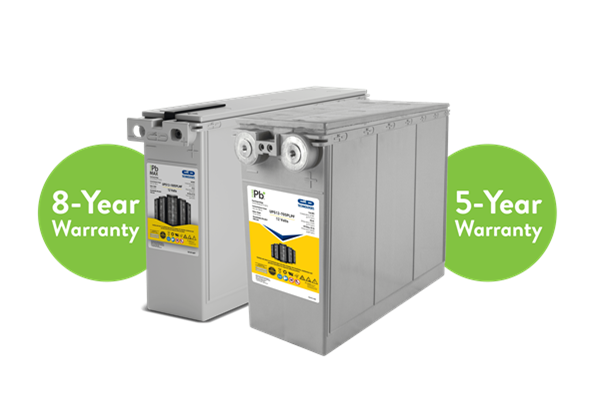
C&D built Pure Lead Max UPS batteries on top of the solid Pure Lead Plus foundation. They have a reduced float current, below that of standard pure lead batteries. This difference enables a favourable TCO in many data centre back-up use cases for Pure Lead Max compared to Lithium and other technologies.
The Pure Lead Max range is perfect for new installations or if implemented in the early stages of a UPS system’s life. Pure Lead Max comes with an 8-year warranty for all customers, subject to applicable terms and conditions.
Compare Pure Lead Plus and Pure Lead Max UPS batteries >
Lithium-Ion batteries for data centres: Targeted Use Cases
Lithium ion continues to expand in applications requiring high energy density, rapid recharge and frequent cycling, particularly in markets with unstable grids.
However, higher upfront costs, additional system and safety requirements, and questions over its current sustainability and recyclability limit its universal adoption in some cases.
Key Considerations
1. Power availability is key
More than ever, companies will build data centres where power and infrastructure are available. This helps support rapid growth, led mainly by AI.
2. Trust but verify (EU compliance)
Regulations are changing fast and there are different expectations for each product being purchased. Evaluate your suppliers on their ability to help you achieve those levels of compliance. Their willingness to partner with you and develop what you need is crucial.
3. Choose your technology path wisely
With so many good options for your battery technology, it has never been easier to balance TCO with sustainability. Make sure you are considering all aspects of the entire battery lifecycle. This will ensure you are making the best short- and long-term decisions.
With over 120 years of battery manufacturing history, we do not see this regulatory evolution as an obstacle. We see it as an opportunity that accelerates innovation, enhances transparency, and advances sustainable energy solutions across the data centre ecosystem.

About the author
Gerrit Barnard serves as Director of Sales EMEA at C&D Technologies, leveraging his extensive experience in energy storage to support telecom and data centre customers.
Recognized for execution excellence, Gerrit contributes to the company’s longstanding reputation for resilient, reliable data center backup power solutions and ongoing innovation across critical energy applications.
Articles by and about Gerrit Barnard
Legal disclaimer: Pure Lead and Advanced Pure Lead refer to a category of lead acid battery technologies. Pure Lead Plus and Pure Lead Max are proprietary product lines.